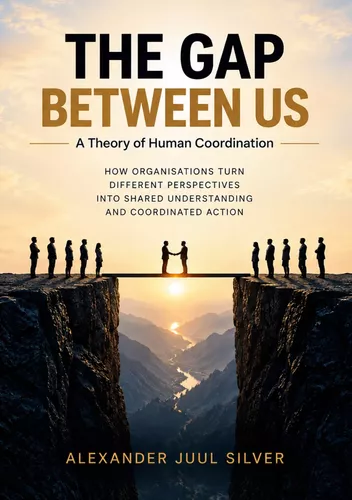
Why do organisations struggle to work together when they are filled with capable people? The answer may have less to do with individual performance than with the gaps between us. The Gap Between Us explores organisations as humanity's technology for coordinating thought. When no individual can hold all the knowledge needed to solve a problem, organisations allow different perspectives, experiences and expertise to be combined. But bringing more minds together creates a new problem: how do those minds develop enough shared understanding to think and act together? Drawing on observations from organisational life, alongside ideas from anthropology, organisational research and the study of collective intelligence, Alexander Juul Silver explores the hidden infrastructure that makes coordination possible: language, shared experience, relationships, trust, strategy and leadership. He argues that organisations accumulate a form of capability through working together an invisible resource that can make future coordination easier, but can also become a source of inertia when the world changes. Transformation, from this perspective, is not simply about changing structures. It is about relearning reality together. And as artificial intelligence becomes increasingly capable of interpreting, connecting and contributing to knowledge, the question becomes even more important: How do we think together?
Alexander Silver works at the intersection of strategy, organisations and technology. With a background in anthropology and management, he has spent his career working on problems that rarely belong neatly to one discipline. His work has brought him across technology, business, operations, fi-nance and regulation, often in situations where different groups under-stand the same problem in very different ways. He is particularly interested in what happens between those perspectives: how people develop a shared understanding, how organisations accu-mulate the ability to work together, and why capabilities that once made an organisation successful can eventually make it harder to change. The Gap Between Us grew from that curiosity. It began with a simple observation about organisations and gradually became a broader explo-ration of how human beings coordinate knowledge, judgement and ac-tion when no individual can see the whole picture.









Det finns inga presskommentarer tillgängliga just nu.