
Skip to the end of the images gallery Byt navigering
Skip to the beginning of the images gallery Byt navigering
Ny
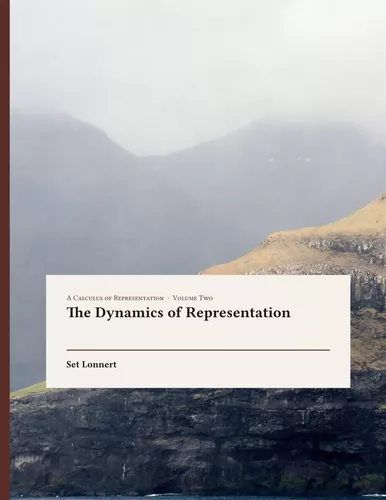
The Dynamics of Representation
Del 2: A Calculus of Representation
ePDF
4,3 MB
Vattenmärkning
ISBN-13: 9789181504897
Förlag: BoD - Books on Demand
Utgivningsdatum: 01.10.2026
Språk: Engelska
Tillgänglighet: Begränsat tillgänglig
finns som:
139,00 kr
inkl. moms
Tillgänglig för nedladdning
Volume Two of: A Calculus of Representation.
This two-volume calculus of representation develops a framework carried since the 1980s: a notation that keeps what there is and how it is grasped on the page at the same time, instead of collapsing either into the other. The first volume sets the notation down, and finds it already present - unremarked, and six centuries apart - in Ockham and in Frege. The second sets it in motion, and asks what a record of an inquiry still holds once the inquiry has changed its mind.
The first book gave two kinds of representational failure a place on one page. But a notation that holds an object apart from the way it is given is a still picture, and inquiry is not still. Sciences change their minds. This book asks what such a notation does when it is made to move.
What moves is a record. Not a set of beliefs closed under consequence, but a finite list of acts in the order they were actually performed: crossings made on a licence, undertakings, and registrations of what simply happened. A state is such a list, an act has an effect on it, and the question worth asking is what survives. Three operations take something back, and none of them will do another's work.
From there the book gives contents parts, puts a value to the coordinate the first volume deliberately left uncommitted, and adds a second agent who takes up what a first has undertaken. Then it runs the whole apparatus over four cases: the infinitesimal, light between 1900 and 1925, negation as failure, and precedent in conflict.
There is no axiomatisation here, no consequence relation and no completeness result - and none of the three is missing. A consequence relation is indifferent to how a premise was arrived at; that is its whole use, not a defect in it. This book exists to ask which way an inquiry was going, which is a question about how one came by something and about nothing else.
A reader who has not read the first volume should not be at a disadvantage.
This two-volume calculus of representation develops a framework carried since the 1980s: a notation that keeps what there is and how it is grasped on the page at the same time, instead of collapsing either into the other. The first volume sets the notation down, and finds it already present - unremarked, and six centuries apart - in Ockham and in Frege. The second sets it in motion, and asks what a record of an inquiry still holds once the inquiry has changed its mind.
The first book gave two kinds of representational failure a place on one page. But a notation that holds an object apart from the way it is given is a still picture, and inquiry is not still. Sciences change their minds. This book asks what such a notation does when it is made to move.
What moves is a record. Not a set of beliefs closed under consequence, but a finite list of acts in the order they were actually performed: crossings made on a licence, undertakings, and registrations of what simply happened. A state is such a list, an act has an effect on it, and the question worth asking is what survives. Three operations take something back, and none of them will do another's work.
From there the book gives contents parts, puts a value to the coordinate the first volume deliberately left uncommitted, and adds a second agent who takes up what a first has undertaken. Then it runs the whole apparatus over four cases: the infinitesimal, light between 1900 and 1925, negation as failure, and precedent in conflict.
There is no axiomatisation here, no consequence relation and no completeness result - and none of the three is missing. A consequence relation is indifferent to how a premise was arrived at; that is its whole use, not a defect in it. This book exists to ask which way an inquiry was going, which is a question about how one came by something and about nothing else.
A reader who has not read the first volume should not be at a disadvantage.

Skriv din egen recension



Det finns inga presskommentarer tillgängliga just nu.