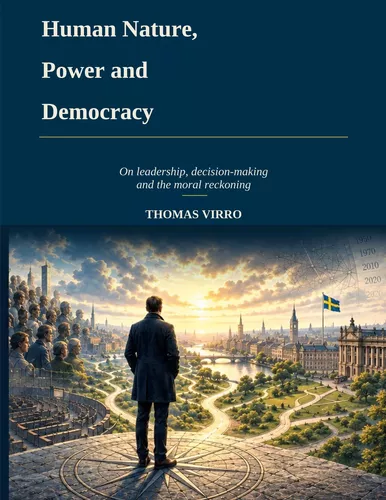
Human Nature, Power and Democracy explores one of the oldest and most persistent questions of human society: how power is acquired, exercised, justified and eventually relinquished.
Drawing on political psychology, decision research, history and the institutions of democracy, Thomas Virro examines how leaders are selected, how group loyalty and moral conviction shape judgement, and how power itself can alter a person's perception of reality. What happens when confidence becomes certainty, when loyalty discourages dissent, or when political decision making takes place under pressure, incomplete information and an uncertain future?
Through figures such as Klimov, Coudenhove Kalergi, Solzhenitsyn and Hans von Rosen, the book contrasts different ideas about leadership, elites and authority. Modern research into Situation Awareness and decision making is used alongside historical examples to explore how politicians, experts, the media and citizens interpret information and make choices.
At its heart, the book is a defence of democracy not because democratic societies are governed by better human beings, but because democracy recognises something more fundamental: all human beings are fallible.
Power must therefore be questioned, scrutinised, limited and ultimately capable of being transferred. At its heart, the book is a defence of democracy not because democratic societies are governed by better human beings, but because democracy recognises something more fundamental: all human beings are fallible. Power must therefore be questioned, scrutinised, limited and ultimately capable of being transferred.
Thomas Virro writes about human nature, history, identity and the choices that shape our lives. His work is concerned with responsibility, judgement and the attempt to understand why people act as they do.
In Human Nature, Power and Democracy, he brings together political psychology, decision research and historical experience to examine the human relationship with authority from the desire to lead and the exercise of power to the more difficult task of accepting limits, relinquishing office and taking responsibility for the consequences of one's decisions.
His approach is reflective rather than partisan, using history and research as tools for examining the enduring tension between human fallibility, leadership and democratic responsibility.









Det finns inga presskommentarer tillgängliga just nu.